 DE
DE
 EN
EN

TU Berlin / HRI analysis: more uniform air cleaning from above
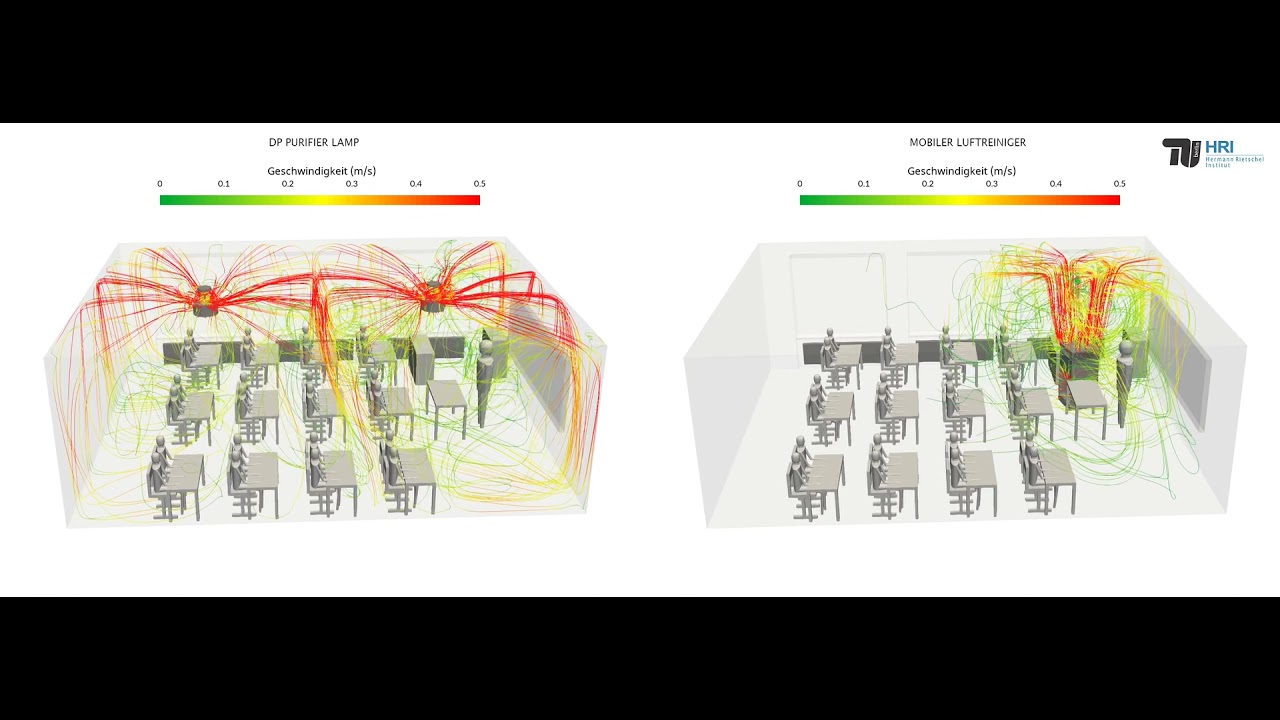
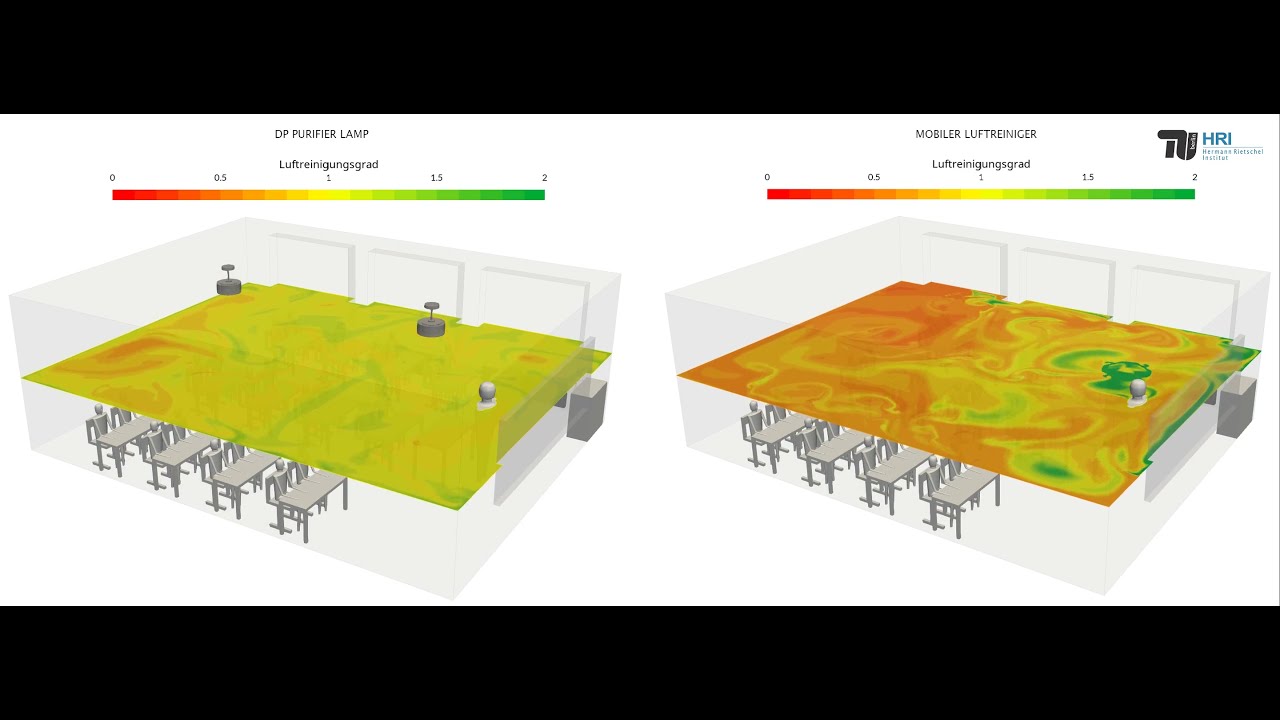
Independent airflow analysis by Technical University (TU) Berlin / Hermann-Rietschel-Institut (HRI) compared the ceiling-mounted DP Purifier Lamp with a mobile floor-standing air purifier in a simulated classroom. The results indicate more homogeneous air purification in the occupied zone and at breathing height with the ceiling-mounted dp concept under the analysed conditions.

Airflow analysis by TU Berlin / HRI
The dp Purifier Lamp was analysed by Technical University (TU) Berlin / Hermann-Rietschel-Institut (HRI) in a classroom airflow simulation. The study compared two ceiling-mounted dp Purifier Lamps with one mobile floor-standing air purifier under the same recirculation airflow conditions.
Prof. Dr. Martin Kriegel and Dr.-Ing. Stefan Brandt — researchers at the Department of Health, Welfare, and Energy at TU Berlin's Hermann-Rietschel-Institut — together with Dipl.-Ing. Eugen Lichtner, conducted the comparative airflow analysis modelling the distribution of suspended particles and airflow patterns in an occupied indoor classroom environment. The study used a 60 m² classroom model with 24 students and one teacher, analysing recirculation airflow rates of 760 m³/h and 1,000 m³/h.
The results indicate that the ceiling-mounted dp concept can provide more homogeneous air purification in the occupied zone and a higher average air purification level at breathing height compared with the analysed mobile floor-standing purifier under the simulated conditions. Research development on indoor airborne particle movement began in 2017, with the landmark short study published on 17 August 2021.

What was analysed
The Technical University Berlin / HRI short study compared two ceiling-mounted dp Purifier Lamps with one mobile floor-standing air purifier in a simulated classroom with 24 students and one teacher. The classroom model had a floor area of 60 m² and a height of 3.0 m. Recirculation airflow rates of 760 m³/h and 1,000 m³/h were analysed.
What the analysis indicates
The TU Berlin / HRI classroom simulation highlights how installation position and air distribution influence the effectiveness of air purification in the occupied zone.
Why ceiling placement matters for air distribution
Small airborne particles and aerosols can remain suspended in indoor air for long periods and are strongly influenced by airflow patterns, thermal plumes, ventilation and room geometry.
Classroom simulation: dp vs mobile floor-standing purifier
A simulated classroom with 24 students and one teacher in a 60 m² room, 3.0 m ceiling height — a comparative airflow analysis under controlled simulation conditions.
Technical University Berlin / Hermann-Rietschel-Institut analysed the DP Purifier Lamp in comparison with a mobile floor-standing air purifier in a simulated classroom with 24 students and one teacher. The results indicate that the ceiling-mounted dp concept can provide more homogeneous air purification in the occupied zone and a higher average air purification level at breathing height under the analysed conditions. The study also shows that uniform air introduction over the room area can improve the air purification effect with the same design volume flow. At the same time, airflow and comfort must be balanced to avoid draught risk.
See the airflow analysis in action
Watch simulation visualisations from the Technical University Berlin / HRI airflow analysis and dp system demonstrations.
From concept to independent airflow analysis
Several years of product development, airflow analysis and real-world application.
Technical specifications
Engineering data for dp Pro and dp Industrial. Airflow behaviour was analysed by Technical University Berlin / Hermann-Rietschel-Institut.