
📋 Independent Airflow Analysis

TU Berlin / HRI analysis: more uniform air cleaning from above

Independent airflow analysis by Technical University (TU) Berlin / Hermann-Rietschel-Institut (HRI) compared the ceiling-mounted DP Purifier Lamp with a mobile floor-standing air purifier in a simulated classroom. The results indicate more homogeneous air purification in the occupied zone and at breathing height with the ceiling-mounted dp concept under the analysed conditions.

🏛 Technical University Berlin / Hermann-Rietschel-Institut
📅 Classroom Simulation
📊 Airflow Analysis 2021
🔬 HEPA H14 Filtration
60 m² Classroom model
24+1 24 students + 1 teacher
760/1,000 m³/h recirculation airflow
2021 TU Berlin / HRI analysis
dp purifier
Department of Health, Welfare & Energy — Hermann-Rietschel-Institut, Technical University of Berlin
HEPA H14 filter efficiency: ≥99.995% at MPPS according to EN 1822. This refers to filter efficiency, not room-air cleaning efficiency.
The Research

Airflow analysis by TU Berlin / HRI

"Experimental tests and verification have been conducted by the Department of Health, Welfare, and Energy at the Hermann-Rietschel-Institut, Technical University of Berlin." — dp purifier airflow analysis documentation

The dp Purifier Lamp was analysed by Technical University (TU) Berlin / Hermann-Rietschel-Institut (HRI) in a classroom airflow simulation. The study compared two ceiling-mounted dp Purifier Lamps with one mobile floor-standing air purifier under the same recirculation airflow conditions.

Prof. Dr. Martin Kriegel and Dr.-Ing. Stefan Brandt — researchers at the Department of Health, Welfare, and Energy at TU Berlin's Hermann-Rietschel-Institut — together with Dipl.-Ing. Eugen Lichtner, conducted the comparative airflow analysis modelling the distribution of suspended particles and airflow patterns in an occupied indoor classroom environment. The study used a 60 m² classroom model with 24 students and one teacher, analysing recirculation airflow rates of 760 m³/h and 1,000 m³/h.

The results indicate that the ceiling-mounted dp concept can provide more homogeneous air purification in the occupied zone and a higher average air purification level at breathing height compared with the analysed mobile floor-standing purifier under the simulated conditions. Research development on indoor airborne particle movement began in 2017, with the landmark short study published on 17 August 2021.
Research Team
K
Prof. Dr. Martin Kriegel Hermann-Rietschel-Institut, Technical University Berlin
B
Dr.-Ing. Stefan Brandt Hermann-Rietschel-Institut, Technical University Berlin
L
Dipl.-Ing. Eugen Lichtner Hermann-Rietschel-Institut, Technical University Berlin
CE stamp
CE Certified Airflow analysis by Technical University Berlin / Hermann-Rietschel-Institut. Published 17 August 2021.
Official TU Berlin document
Study Setup

What was analysed

The Technical University Berlin / HRI short study compared two ceiling-mounted dp Purifier Lamps with one mobile floor-standing air purifier in a simulated classroom with 24 students and one teacher. The classroom model had a floor area of 60 m² and a height of 3.0 m. Recirculation airflow rates of 760 m³/h and 1,000 m³/h were analysed.

Classroom Simulation Parameters
Room typeClassroom simulation
Occupants24 students + 1 teacher
Room size60 m²
Room height3.0 m
Heat load2,500 W
Room surface temperature20°C
Airflow analysed760 m³/h and 1,000 m³/h
Pollutant sourceHomogeneously distributed in the room
Particle modelIdeal airborne particles
Separation efficiency in simulation100%
Publication date17 August 2021
AuthorsS. Brandt, E. Lichtner
Key Research Findings

What the analysis indicates

The TU Berlin / HRI classroom simulation highlights how installation position and air distribution influence the effectiveness of air purification in the occupied zone.

🎯
Homogeneous
More homogeneous air purification
The simulation showed that two ceiling-mounted dp Purifier Lamps can achieve very homogeneous air purification at the breathing height of the students
📍
Occupied zone
Improved occupied-zone coverage
The dp Purifier Lamp showed more homogeneous air filtration in the occupied zone compared with the analysed mobile floor-standing purifier
📈
Higher avg.
Higher average air purification level
The study concluded the dp Purifier Lamp achieved a higher average air purification level at breathing height under the analysed classroom conditions
🏫
No obstruction
No floor-space obstruction
Because the dp system is ceiling-mounted, it does not occupy floor space or interfere with classroom layout, furniture or movement
⚖️
Balance
Comfort balance matters
The study notes that high air purification and low air velocity must be balanced. If higher airflow is required, additional ceiling-mounted units should be considered
The Physics

Why ceiling placement matters for air distribution

Small airborne particles and aerosols can remain suspended in indoor air for long periods and are strongly influenced by airflow patterns, thermal plumes, ventilation and room geometry.

🌡
Core principle
Micro-sized particles can remain suspended — and are strongly influenced by airflow patterns
Small airborne particles and aerosols can remain suspended in indoor air for long periods. Their movement is strongly influenced by airflow patterns, thermal plumes, ventilation and room geometry. Ceiling-mounted air purification allows air to be drawn from above the occupied zone and redistributed across the room after filtration. The dp Purifier Lamp, suspended at 2.5 metres from the ground at the room's centre, is positioned to draw air from above the occupied zone and distribute filtered air radially. Mobile floor-standing purifiers positioned in corners or against walls have limited reach and can typically only clean the air in their immediate vicinity.
🔵
Filtration and hygiene concept
HEPA H14 + Activated Carbon + Internal UV-C
The dp system combines HEPA H14 filtration according to EN 1822, activated carbon for odour and selected VOC reduction, and an internal UV-C hygiene stage designed to support hygienic conditions on the filter surface inside the closed device. Output air is distributed radially across the room after filtration.
💨
Engineered airflow geometry
Radial air distribution across the room
The airflow geometry is designed to distribute filtered air radially across the room and support continuous mixing in the occupied zone, helping maintain a more uniform air quality environment throughout the space.
🔬
Particle coverage
HEPA H14 filtration for airborne particles
HEPA H14 filtration according to EN 1822 supports the reduction of airborne particles, aerosols, fine particulate matter, pollen, mould spores, dust, and particle-bound biological contaminants. Activated carbon supports odour and selected VOC reduction.
Simulation Data

Classroom simulation: dp vs mobile floor-standing purifier

A simulated classroom with 24 students and one teacher in a 60 m² room, 3.0 m ceiling height — a comparative airflow analysis under controlled simulation conditions.

Test Environment Parameters
Room size60 m² × 3.0 m ceiling
Occupants24 students + 1 teacher
Heat load2,500 W
Temperature20°C
Airflow analysed760 m³/h and 1,000 m³/h
Publication date17 August 2021
AuthorsS. Brandt, E. Lichtner
dp Purifier Lamp — Analysed Configuration
System typeCeiling-mounted recirculating air purifier
Units analysed2 × dp Purifier Lamp
Airflow per unit380 m³/h and 500 m³/h
Total airflow analysed760 m³/h and 1,000 m³/h
InstallationCeiling-mounted / ceiling-suspended
FiltrationHEPA H14 + Activated Carbon + UV-C
Main resultMore homogeneous air purification in occupied zone and higher average air purification level at breathing height
dp Purifier Lamp — Ceiling-Mounted More homogeneous
Occupied zone
High
Breathing ht.
Uniform
Floor space
Free
Mobile Floor-Standing Purifier Locally limited
Occupied zone
Variable
Breathing ht.
Uneven
Local zone
Only
Technical University Berlin / HRI conclusion
The airflow analysis concluded that there is a balance between high air purification and low air velocity. Uniform air introduction over the room area resulted in higher air purification with the same design volume flow. In the analysed classroom model, the dp Purifier Lamp provided more homogeneous air filtration in the occupied zone and a higher average air purification level at breathing height compared with the analysed mobile air purifier.
Important nuance
The study notes that high air purification and low air velocity must be balanced. If higher airflow is required, additional ceiling-mounted units should be considered to maintain comfort and reduce draught risk.
Summary conclusion

Technical University Berlin / Hermann-Rietschel-Institut analysed the DP Purifier Lamp in comparison with a mobile floor-standing air purifier in a simulated classroom with 24 students and one teacher. The results indicate that the ceiling-mounted dp concept can provide more homogeneous air purification in the occupied zone and a higher average air purification level at breathing height under the analysed conditions. The study also shows that uniform air introduction over the room area can improve the air purification effect with the same design volume flow. At the same time, airflow and comfort must be balanced to avoid draught risk.

Research Videos

See the airflow analysis in action

Watch simulation visualisations from the Technical University Berlin / HRI airflow analysis and dp system demonstrations.
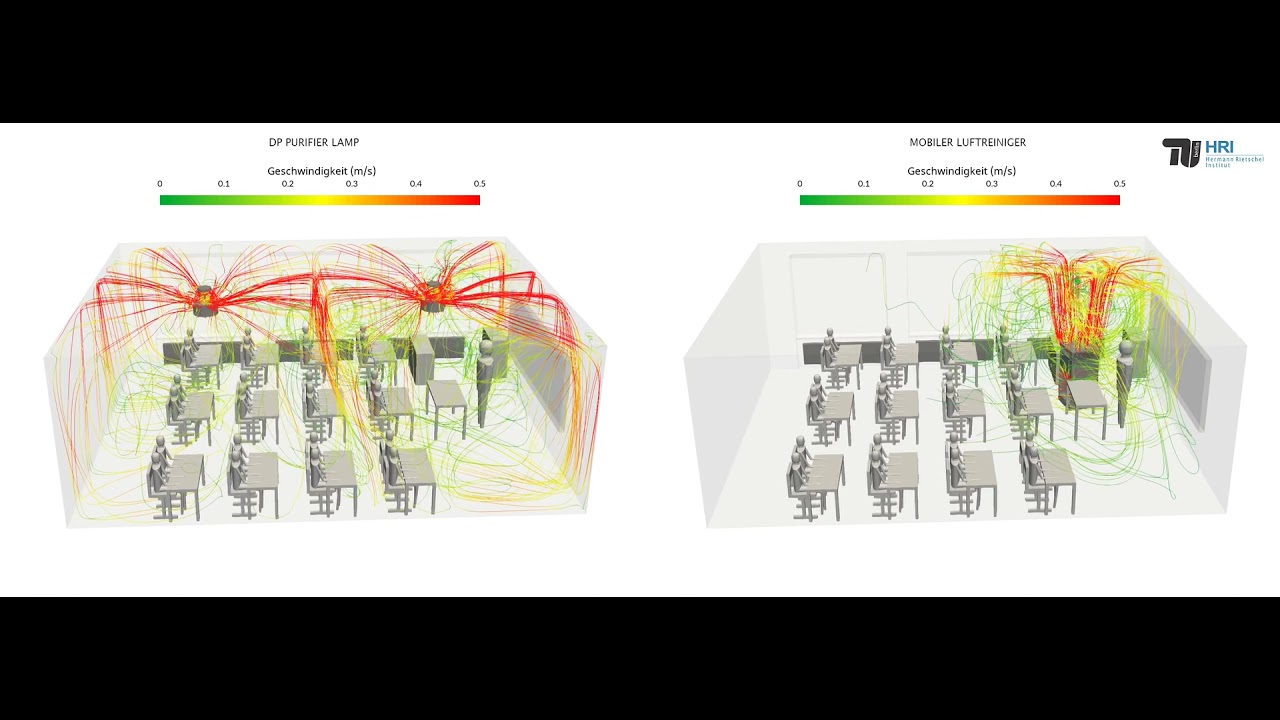
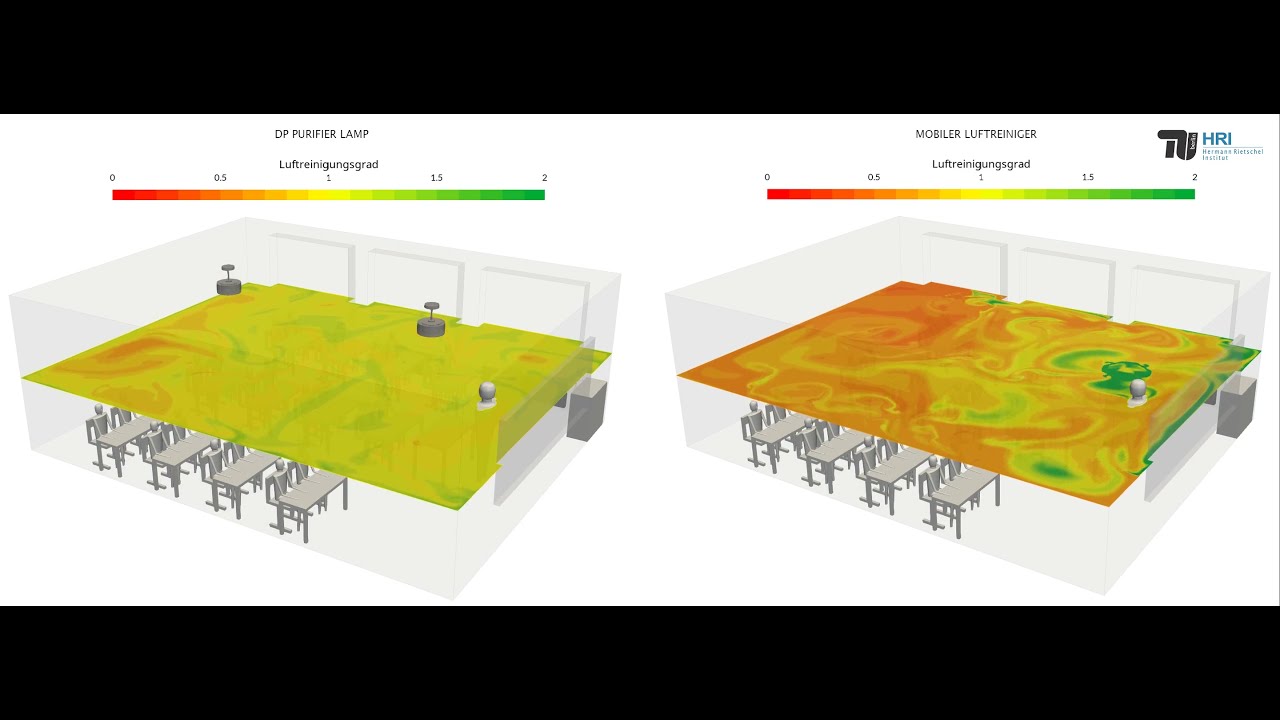
TU Berlin airflow simulation
TU Berlin / HRI Airflow Simulation Airflow simulation of a mobile floor-standing purifier CFD visualisation showing localised air purification effects and larger differences across the occupied zone when using a mobile floor-standing purifier in the simulated classroom.
dp ceiling-mounted distribution
dp Ceiling-Mounted Distribution dp ceiling-mounted distribution — airflow visualisation Visual demonstration of ceiling-mounted installation and radial air distribution across the room, consistent with the airflow patterns analysed in the Technical University Berlin / HRI simulation.
Research Timeline

From concept to independent airflow analysis

Several years of product development, airflow analysis and real-world application.

2017
Research begins — indoor particle movement Initial research focused on indoor airflow and suspended particle movement. Fine particles and aerosols can remain suspended and are strongly influenced by airflow patterns, thermal plumes and room geometry. These findings informed the ceiling-mounted dp concept.
2019–2020
Device development — airflow and filtration design Prototype development focused on aerodynamics, HEPA H14 filtration according to EN 1822, activated carbon and internal UV-C hygiene support. The ceiling-mounted concept and 360° air distribution geometry were further developed and refined.
2021
Technical University Berlin / HRI airflow analysis Technical University Berlin / Hermann-Rietschel-Institut analysed the dp Purifier Lamp in a classroom simulation with 24 students and one teacher, comparing the ceiling-mounted dp concept with a mobile floor-standing air purifier. Authors: S. Brandt, E. Lichtner.
17 Aug 2021
Publication: "Classroom Air Purifier — DP Purifier Lamp and Mobile Air Purifier" The short study analysed airflow distribution and air purification in a classroom model. It found that the ceiling-mounted dp Purifier Lamp supported more homogeneous air purification in the occupied zone and a higher average air purification level at breathing height under the analysed conditions.
2021–Present
Field application — schools, hospitals, offices and commercial spaces dp systems have been installed in educational, healthcare, office, commercial and industrial environments. Field measurements, CE certification and the Technical University Berlin / HRI airflow analysis support ongoing product development and project specification.
Specifications

Technical specifications

Engineering data for dp Pro and dp Industrial. Airflow behaviour was analysed by Technical University Berlin / Hermann-Rietschel-Institut.

dp Pro
dp Industrial
Performance & Filtration
Max air cleaning flow860 m³/h / 860,000 L/h
Filter efficiency (HEPA H14 at MPPS)≥99.995% according to EN 1822 — filter level only
Filter classHEPA H14 + optional activated carbon
UV-C wavelength270–280 nm (internal, closed device)
Filter life~2,200 working hours
Suitable for (home)Up to approx. 55 m², depending on ceiling height, usage and target ACH
Suitable for (office/school)Up to approx. 40 m² as a planning reference, depending on occupancy, ceiling height and target ACH
Physical & Electrical
Weight10 kg
Dimensions227 mm × 445 mm
Colour optionsBlack or white + custom lampshade
Voltage220–240 V
Power consumption5 W minimum / 120 W maximum
Sound pressure40–65 dB
Light colour temperature2,000–6,000 K
Connectivity & Control
Remote controlProgramme control of up to 15 devices
Network capacityUp to 100 devices
App platformAndroid & iOS
Lighting controlIndividual light strip control via app
dp HUBMulti-device local network panel
Auto modeAutomatic fan speed adjustment
Compliance & Testing
CertificationCE / BIS certified
Airflow analysisTechnical University Berlin / Hermann-Rietschel-Institut
Filter standardEN 1822 — HEPA H14 filter classification
Particle reductionPM2.5 and PM10 — field measurements and correct sizing
Pollen, mould spores, dustHEPA H14 filtration helps reduce airborne particles
Cigarette smoke & odoursParticle filtration + activated carbon for odour reduction
Pet danderHEPA H14 filtration helps reduce airborne pet dander
Performance & Filtration
Max air cleaning flow1,780 m³/h / 1,780,000 L/h
Filter efficiency (HEPA H14 at MPPS)≥99.995% according to EN 1822 — filter level only
Filter classHEPA H14 + optional activated carbon
UV-C wavelength270–280 nm (internal, closed device)
Filter life~4,200 working hours
Room areaUp to 85 m² (additional units for larger spaces)
Physical & Electrical
Weight13 kg
Dimensions540 mm × 640 mm
Colour optionsIndustrial white + customisable
Voltage220–240 V
Power consumption5 W minimum / 220 W maximum
Sound pressure40–65 dB
Connectivity & Control
Remote controlProgramme control of up to 15 devices
Network capacityUp to 100 devices
App platformAndroid & iOS
dp HUBMulti-device local network panel
Auto modeAutomatic fan speed adjustment
Compliance & Testing
CertificationCE / BIS certified
Airflow analysisTechnical University Berlin / Hermann-Rietschel-Institut
Filter standardEN 1822 — HEPA H14 filter classification
Particle reductionPM2.5 and PM10 — field measurements and correct sizing
Pollen, mould spores, dustHEPA H14 filtration helps reduce airborne particles
Cigarette smoke & odoursParticle filtration + activated carbon for odour reduction
Pet danderHEPA H14 filtration helps reduce airborne pet dander
Download the airflow analysis
Access the airflow analysis, product brochure and architectural datasheet — and see how dp compares with a mobile floor-standing purifier under the analysed classroom conditions.